
Review · KATHMANDU
Annapurna Base Camp Trek
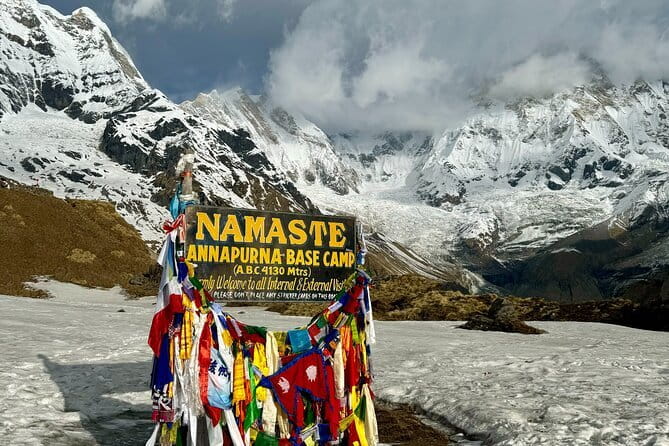
Annapurna Base Camp gives you a lot of Nepal in one trek: terraced hills, forest paths, stone stairways, Gurung and Magar villages, and a high mountain bowl surrounded by giant peaks. The best moment comes at 4,130 meters, when Annapurna I, Annapurna South, Machhapuchhare, and Hiunchuli close in around the sanctuary.
I like the route’s variety. You get sunrise from Poon Hill before reaching the main objective, and you finish with a soak at natural hot springs in Jhinu Danda. I also like the practical setup, with airport transfers, permits, a guide, porters, meals, and accommodation arranged for you.
The main caution is physical effort. This is not a casual walk. Expect long days, steep stone steps, a high point above 13,500 feet, and basic guesthouse accommodation. Train for stairs, pack lightly, and buy insurance that covers high-altitude rescue.
Key points to know before you book
- The highest point is Annapurna Base Camp at 4,130 meters: Altitude matters, even on a route considered manageable for trekkers with moderate fitness.
- Poon Hill adds a famous sunrise stop: You leave early from Ghorepani, but the mountain views make the short climb worthwhile.
- The route is full of stairs: Ulleri, Chhomrong, and the descent toward Jhinu Danda all test your knees and lungs.
- Your group can include up to 15 people: A licensed English-speaking guide leads the trek, with one porter assigned for every two clients.
- The package covers most major costs: Hotels, guesthouses, permits, meals on trek, transport, guides, porters, and airport transfers are included.
- The finish is gentler: A walk beside the Modi Khola, a return to Pokhara, boating on Phewa Lake, and a farewell dinner round out the trip.
Why this Annapurna route is so rewarding
The Annapurna Base Camp Trek is a strong choice if you want a classic Himalayan trek without spending three weeks on the trail. At $1,350 per person, the package covers 13 days, two hotel nights in Kathmandu, two in Pokhara, eight nights in guesthouses, trekking permits, a guide, porter support, transport, and most meals.
That matters because Nepal trekking costs can spread across many small payments. Here, airport pickup, the tourist bus, the vehicle to Nayapul, lodging, and official fees are bundled together. You still need to budget for drinks, meals in Kathmandu and Pokhara, equipment, insurance, tips, international airfare, and your Nepal entry visa.
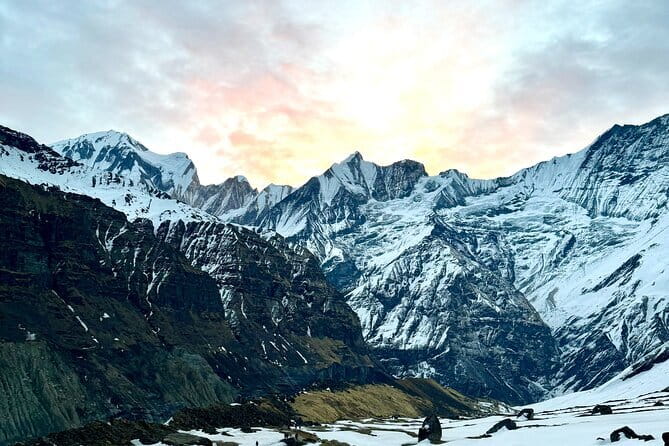
The route works because it changes scenery often. The early days pass through lower hill country and farming villages. Rhododendron and oak forests take over around Ghorepani and Tadapani. Then the trail narrows into the Modi Khola valley before opening into the Annapurna Sanctuary, a mountain amphitheater that feels far removed from city life.
You also get a useful cultural side trip. The villages around Chhomrong, Gurjung, and the wider Annapurna region show modern hill life rather than a staged cultural display. The trek is active, but you are not simply marching from one viewpoint to another.
More Annapurna treks around Kathmandu:
- Annapurna Circuit Trek with Tilicho Lake
★ 5.0 · 368 reviews - Annapurna base camp trek 5 Days
★ 5.0 · 252 reviews - 14-Day Private Annapurna Base Camp Trek
★ 5.0 · 180 reviews
Days 1 and 2: Kathmandu to Pokhara
Your trip starts at Tribhuvan International Airport, where an Ace the Himalaya representative meets you outside the terminal and transfers you to your hotel. On the first or second day, you attend a pre-trip meeting, meet your trek leader, settle any remaining balance, and hand over the required insurance copy and passport photographs.
This meeting is useful. Bring your passport, three passport-size photos, and a readable copy of travel insurance. Your policy must cover emergency high-altitude rescue and evacuation. A standard medical policy may not be enough, so check the wording before you fly.
The next morning starts early. Staff collect you from your hotel at about 6:30 a.m. and take you to the tourist bus station. The bus to Pokhara leaves around 7:30 a.m., and the journey takes much of the day.
Pokhara is a calmer place to begin a mountain trek. It sits beside Phewa Lake, with views toward Annapurna, Machhapuchhare, Dhaulagiri, Lamjung Himal, and Manaslu when conditions are clear. You have two hotel nights in Pokhara within the package, and that gives you time to get organized before the trail.
The bus ride is included, but it is still a long road day. If you prefer private transport, ask about an upgrade before booking. The advertised package provides a tourist bus, not a private car, between Kathmandu and Pokhara.
Days 3 and 4: Nayapul, Tikhedhunga, Ulleri, and Ghorepani
From Pokhara, a private vehicle takes you to Nayapul. The walking begins beside the Modi Khola, with a short stretch to Birethanti at 1,015 meters. This large village has shops and teahouses, and it marks the point where the route starts feeling like a proper trek.
You follow the Bhurungdi Khola toward Hille and Tikhedhunga. The first walking day is relatively short and serves as a gentle introduction. Do not let that easy start fool you. The next day brings the famous climb to Ulleri, a large Magar village at 2,070 meters.
From Ulleri, the trail rises through oak and rhododendron forest toward Banthanti and Nangethanti. Ghorepani sits at about 2,840 meters, so this is a real gain in height over a short period. The stone steps are steady and can feel repetitive, especially if you are carrying too much.
This is where the porter system becomes valuable. One porter is provided for every two clients, so keep your personal daypack modest and use the supplied duffel bag for the bulk of your gear. One practical piece of advice is simple: bring fewer clothes than you first think you need. The porters have to carry every extra shirt.
Guesthouse accommodation is basic. You should expect shared or twin-share rooms during the trek, rather than the privacy and facilities of the three-star hotels in Kathmandu and Pokhara. Meals on the trekking days are included, while alcoholic drinks, hot drinks, and cold drinks are not.
Day 5: Poon Hill sunrise and the road to Tadapani
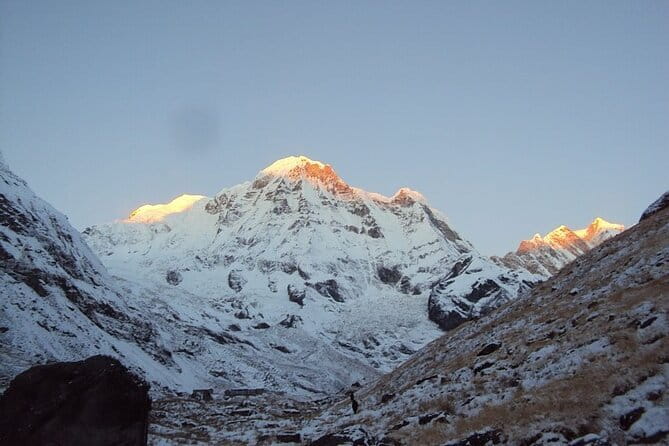
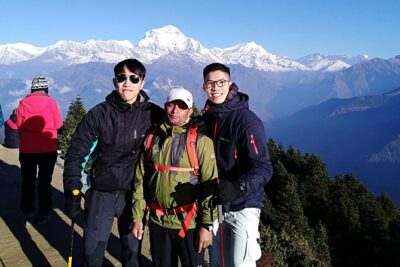
The early morning walk to Poon Hill is one of the trip’s best features. From Ghorepani, you climb for about an hour to an elevation of 3,210 meters. The aim is sunrise over the high Himalayas, with an open mountain view when the sky cooperates.
You spend about an hour at the viewpoint before returning to Ghorepani for a hot breakfast. This early start can be cold and tiring, but it gives you a major mountain panorama before the deeper part of the route begins.
After breakfast, the trail climbs along ridges and passes through pine and rhododendron forest toward Deurali. You then descend to Banthanti and continue to Tadapani. This day combines an early uphill push, forest walking, and another descent, so it can feel longer than the distance suggests.
Poon Hill also gives you a useful preview of the high-country scenery. The final view from Annapurna Base Camp is more enclosed and dramatic, while Poon Hill offers a broader sweep. Having both viewpoints makes the route feel more complete.
More treks around Kathmandu:
- Everest Base Camp Trek – 14 Days
★ 5.0 · 1,499 reviews - Everest Base Camp Trek
★ 5.0 · 842 reviews - Everest Base Camp Trekking
★ 5.0 · 485 reviews - Everest Base Camp Trekking – 13 Day
★ 5.0 · 365 reviews
Day 6: Tadapani to Chhomrong
The trail drops steeply through rhododendron forest from Tadapani. You pass through Gurjung, a village associated with the Gurung people, and then walk more easily toward Chhomrong at about 2,140 meters.
Chhomrong is an important staging point for the Annapurna Sanctuary. It is also a reminder that this trek is not a straight climb. You gain and lose height as the path follows the valleys, so the total effort can be greater than the final altitude numbers suggest.
The steep steps around Chhomrong are a good reason to train on stairs before Nepal. Strong walking legs help, but your knees also need preparation for the descents. Trekking poles can be useful, though personal trekking equipment is not included in the price.
Days 7 and 8: Into the Annapurna Sanctuary
From Chhomrong, the route drops to the Chhomrong Khola before climbing again toward Khuldighar. The path then descends steeply along a rocky section and enters a narrow gorge with bamboo and rhododendron.
You continue through the forest toward Himalayan Hotel and Dovan. Water, shade, and dense vegetation shape this part of the trek. It feels quite different from the open views around Poon Hill, and the constant changes keep the walking interesting.
The following day takes you past Hinko Cave and Deurali to Machhapuchhare Base Camp. The name can be confusing because climbing Machhapuchhare is not permitted, so this is not a launch point for an ascent. It is instead a high stopping place on the way to the sanctuary.
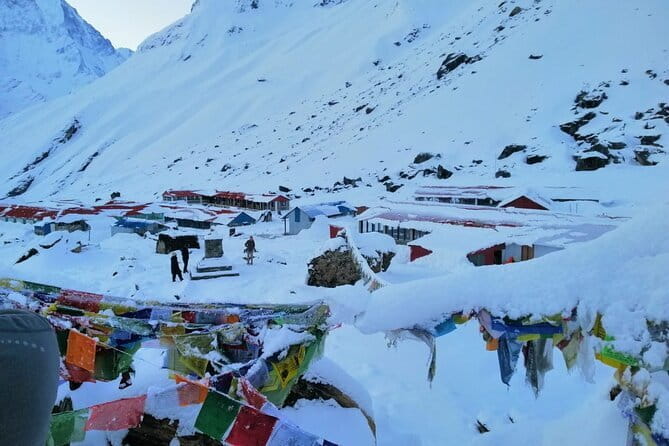
From Machhapuchhare Base Camp, allow about two hours to reach Annapurna Base Camp. At 4,130 meters, you are surrounded by Annapurna I at 8,091 meters, Annapurna South at 7,219 meters, Machhapuchhare at 6,993 meters, and Hiunchuli at 6,441 meters.
This is the emotional center of the trek. The setting is enclosed, huge, and unusually direct. You are not viewing the mountains from a distant ridge. You are standing inside a ring of peaks.
Altitude can affect anyone, regardless of age or previous hiking experience. Walk at the guide’s pace, communicate clearly if you feel unwell, and rely on the guide’s judgment about rest or descent. The itinerary includes no separate acclimatization day at ABC, so steady pacing matters.
Days 9 and 10: Descending to Bamboo and Jhinu Danda
You retrace the trail from the base camp, dropping about 1,700 meters toward the Modi Khola and Bamboo at 2,345 meters. Descending sounds easier than climbing, but the long downhill can be hard on knees and toes.
The next day returns toward Chhomrong, then continues through rhododendron and bamboo areas toward Jhinu Danda. Along the way, you pass an experimental sheep farm near Khuldighar. At Jhinu, you can bathe in natural hot springs.
The hot springs are a well-chosen finish to the high part of the trek. After several days of stairs and uneven ground, warm water offers a simple reward. Bring a swimsuit and a small towel if you want to use the springs, though the supplied information does not specify what facilities are available.
Days 11 to 13: Pokhara, Kathmandu, and departure
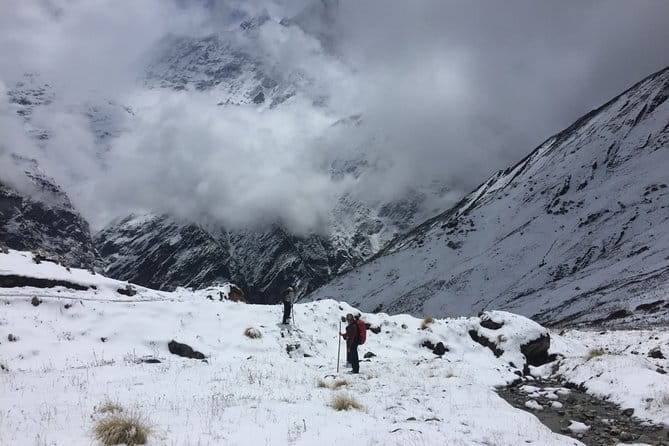
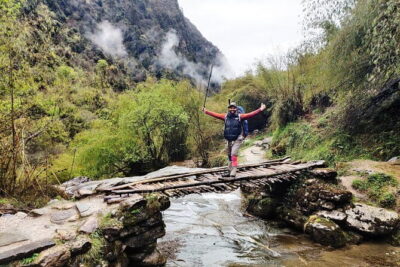
From Jhinu Danda, you walk beside the Modi Khola for about four and a half hours to Birethanti and then continue to Nayapul. This is one of the easier and more relaxing walking sections, with the river and lower hills replacing the steep mountain path.
A vehicle takes you back to Pokhara, where you check into the hotel and walk to Phewa Lake for a boating trip to Barahi Temple. This gives you a quiet pause after the trek, and it makes the two-night Pokhara stay more than a transport stop.
The following morning, you drive back to Kathmandu. In the evening, the package includes a farewell dinner at a traditional Nepalese restaurant with cultural performances. The trip ends the next day with an airport transfer to Tribhuvan International Airport.
The itinerary allows optional extensions to Chitwan, river rafting, shopping, or mountain biking, but those are not included. If you add extra nights or activities, confirm the arrangements and costs before you commit.
Guides, porters, and group size
The maximum group size is 15 people. That is large enough to provide company, but small enough for the guide to keep the group together on a mountain trail. The package includes a licensed English-speaking trekking guide and one porter for every two clients.
The quality of the guide matters more than the size of the group. Named guides associated with recent departures include Ramesh Karki, Maddy, Raj Kumar, Ganesh, Shyam, Resham, and Raj, with assistant guides such as Mahesh and Bhawishya. Your assigned staff may be different, so treat these names as examples rather than a promise.
The strongest part of the service is the personal support on hard days. Guides such as Ramesh, Raj, Maddy, Shyam, and Ganesh have been singled out for encouragement, care, and practical help, while porters including Tenzing, Prakash, Bhagwan, Shantiraj, Ram, Tika Ram, and Lumbu have been praised for their effort and good humor.
Tipping is expected for trekking staff and the driver. The amount is not specified, so ask the operator for current guidance before you arrive. Carry enough Nepalese rupees for tips and personal drinks.
What the $1,350 price really covers
The price is strong for a guided trek of this length, mainly because it includes the costly pieces that are easy to overlook:
- Airport transfers
- Two hotel nights in Kathmandu
- Two hotel nights in Pokhara
- Eight guesthouse nights
- Trekking permits
- Guide and porter support
- Tourist bus between Kathmandu and Pokhara
- Private vehicle between Pokhara and Nayapul
- Breakfast for 12 days
- Lunch and dinner for nine days
- Government taxes and service charges
- A duffel or kit bag and sun hat
You still pay for international airfare, the Nepal visa, travel insurance, drinks, meals in Kathmandu and Pokhara, personal equipment, and tips. The package is not all-inclusive, but it removes much of the planning work.
For a first Nepal trek, that convenience has real value. You do not have to arrange each mountain lodge, permit, transfer, and porter separately. The tradeoff is a set itinerary and shared accommodation, with less flexibility than a fully private custom trek.
Who should book this trek
I would recommend this trek to you if you want a high Himalayan objective but also care about village life, forests, and a few comfortable stops. It suits people with moderate fitness who can handle repeated uphill and downhill walking for several days.
It is a good fit for first-time Nepal trekkers who want a structured package. The airport pickup, pre-trip meeting, guide, porter, meals, and transport make the first trip less complicated.
I would hesitate if you dislike basic rooms, early starts, crowded steps, or long bus rides. I would also choose a different plan if you need a slow acclimatization schedule or prefer private transport and private rooms throughout.
The cancellation terms are simple: cancel at least three full days before the local start time for a full refund. Later cancellations and changes are not refunded, while poor weather may lead to a different date or a full refund.
Should you book the Annapurna Base Camp Trek?
Book it if you want a well-supported 13-day route with a dramatic high point, a famous sunrise, forest trails, hot springs, and a clear beginning and end in Kathmandu. The price is reasonable for what is included, and the guide and porter structure takes care of much of the hard logistics.
Think twice if you want quiet trails, luxury lodging, or a gentle walking holiday. Annapurna Base Camp demands effort, and the stone stairs do not negotiate.
For the best experience, arrive prepared to walk slowly, carry a light daypack, bring proper insurance, and accept that guesthouse life is part of the adventure. The reward is a compact but powerful introduction to Nepal’s mountains and hill communities.
FAQ
How long is the Annapurna Base Camp Trek?
The trek package lasts approximately 13 days, including arrival and departure in Kathmandu, time in Pokhara, the trek to Annapurna Base Camp, and the return journey.
What is the highest point on the route?
Annapurna Base Camp is the highest point, at 4,130 meters or 13,549 feet.
Is airport pickup included?
Yes. An airport representative meets you at Tribhuvan International Airport in Kathmandu and transfers you to your hotel. A transfer back to the airport is also included at the end.
How many people can join the group?
The activity has a maximum group size of 15 people.
What accommodation is included?
You receive twin-share or double rooms in three-star hotels for two nights in Kathmandu and two nights in Pokhara. The trek includes eight nights in guesthouses using twin-share and dormitory rooms.
Are meals included?
Breakfast is included for 12 days. Lunch and dinner are included for nine days. Meals in Kathmandu and Pokhara are not included, and drinks are extra.
Is a guide and porter included?
Yes. The package includes a licensed English-speaking trekking guide and one porter for every two clients.
Do I need travel insurance?
Yes. You must arrange your own insurance, and it should cover emergency high-altitude rescue and evacuation.
Can I cancel for a full refund?
Yes, if you cancel at least three full days before the experience starts. Cancellations made later are not refunded. If poor weather causes the activity to be canceled, you are offered another date or a full refund.
New treks around Kathmandu
- Kathmandu or Pokhara: 5-Day Annapurna Base Camp (ABC) Trek★ 4.5 · 2 reviews
- Pokhara: 2 Day Ghorepani & Poon Hill Private Trekking★ 4.9 · 8 reviews
- From Kathmandu: 6-Day Langtang Valley Guided Trek★ 5.0 · 2 reviews
- Pokhara: 5-Day Annapurna Base Camp (ABC) Trek★ 5.0 · 9 reviews
- Kathmandu: Langtang Valley 6-Day all inclusive Guided Trek★ 5.0 · 2 reviews
- Kathmandu: 6 Days Langtang Valley Trek with Kyanjin Ri★ 5.0 · 7 reviews
- Kathmandu: 9- Day Annapurna Circuit Trek★ 5.0 · 2 reviews
- Kathmandu: 6-Day Limitless Langtang Trek★ 5.0 · 21 reviews
Annapurna Base Camp Treks, side by side.
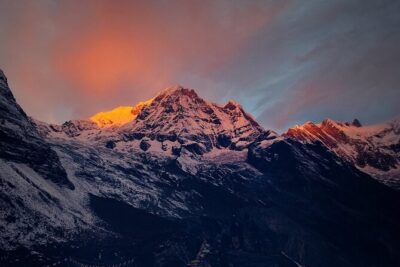
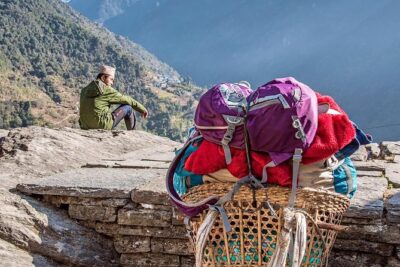
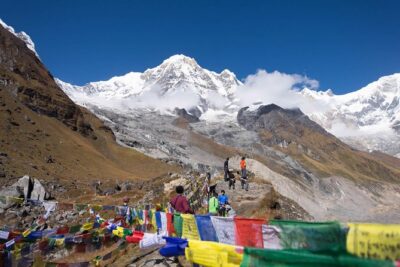
Trekking in Annapurna/Langtang/Everest/Upper Mustang regions
Read our review →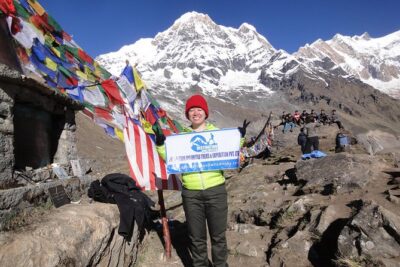
Kathmandu to Annapurna Base Camp (ABC) 5-Day Trek
Read our review →
Lists this trek appears in