
Review · ARUSHA
8-Day Small-group Lemosho Kilimanjaro Summit Trekking
Reaching Uhuru Peak at 19,340 feet is the headline, but the real strength of this trek is the patient route to get there. The 8-day Lemosho itinerary gives you time to cross Kilimanjaro’s changing climate zones and adjust to thin air instead of rushing straight upward.
I like the small-group format, which allows guides to pay closer attention to pace, health, and morale. I also like the practical all-in setup: hotel pickup, camping gear, park fees, meals, and the return transfer are covered. The catch is simple: this is still a demanding high-altitude climb, and a high summit rate does not remove the need for strong fitness or careful preparation.
Key points to know before booking
- Lemosho gives you eight days to acclimatize, including a high-altitude trek to Lava Tower followed by a descent to Barranco Camp.
- The group can include up to 15 people, though some departures may be much smaller.
- Summit night begins around midnight, followed by a steep climb to Stella Point and then Uhuru Peak.
- Guides and crew are a major part of the experience, with names such as Goodluck, John, Herment Mosha, Raymond, Amani, and others associated with different departures.
- The $2,895 price covers major trek essentials, including meals, camping equipment, park fees, and transfers from your Arusha hotel.
- You need strong physical fitness, since summit day combines a long ascent with a long descent.
Why the Lemosho route works well over eight days
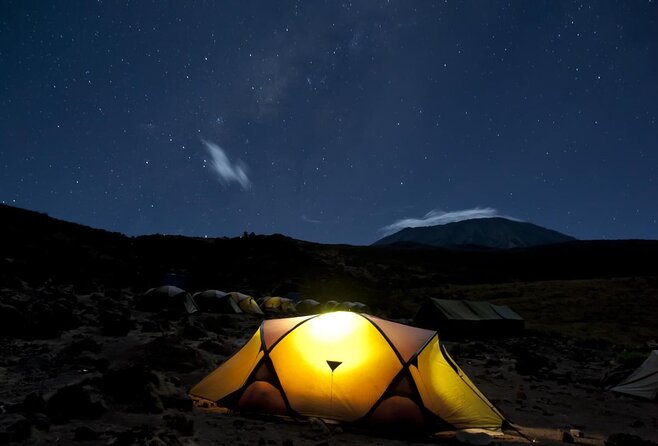
Kilimanjaro is not a technical mountaineering climb on this route, but it is a serious endurance trip. The mountain rises from tropical forest to a freezing summit, and your body has to cope with much less oxygen as you go.
The Lemosho route approaches from the western side of Kilimanjaro. Its early miles are quieter and more gradual than the direct routes, then it joins the southern circuit and uses several camps to build acclimatization. That extra time matters. You are not simply covering distance. You are giving your body more chances to adjust.
I especially like the climb-high, sleep-lower pattern on Day 4. You walk up toward Lava Tower at about 15,000 feet, then descend to Barranco Camp at roughly 13,000 feet. That day is not wasted effort. It helps prepare you for the altitude ahead.
The route also gives you plenty of visual variety. You begin among tall trees and damp forest, cross open heather and volcanic rock, pass through high desert, and eventually reach bare alpine terrain. The scenery changes so often that the climb never feels like one long view of the same mountain.
More Kilimanjaro climbs around the world:
- Best Kilimanjaro Adventure 7 days Machame route Trekking
★ 5.0 · 42 reviews - Kilimanjaro 7 Day Private Trekking Experience
★ 5.0 · 40 reviews - 7 Days Kilimanjaro trek via Machame route
★ 5.0 · 13 reviews
Day 1: Londorossi Gate to Mti Mkubwa Camp
Your day begins with pickup from your Arusha hotel at about 8 a.m. The drive takes you toward the western entrance of Kilimanjaro National Park, where the group checks in at Londorossi Gate.
The first walking section covers about 3 miles and takes roughly three to four hours. You climb gently through the montane forest toward Mti Mkubwa, or Big Tree, Camp at around 7,742 feet.
This is a friendly first day because the distance is short and the trail gains height at a manageable rate. You also get your first sense of how the support system works. Tents are set up at camp, and your personal belongings are placed inside, so you are not carrying a full camping load.
The forest can feel damp, shaded, and enclosed. It is a pleasant contrast to the exposed upper mountain, but do not expect this to be a casual woodland walk. You are already gaining altitude, and the best approach is slow walking from the start.
Day 2: Heather country and the Shira Plateau
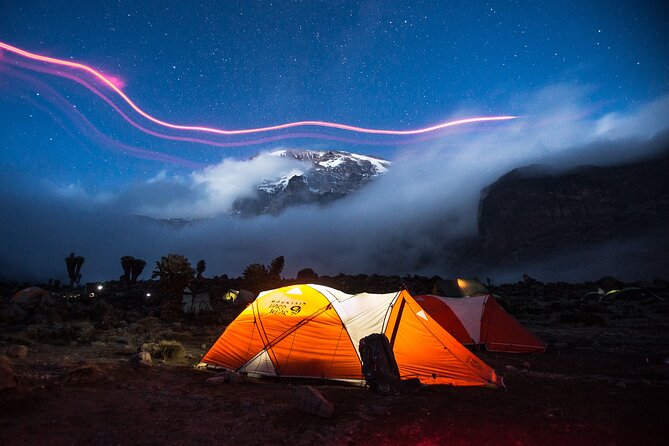
Day 2 covers about 4.9 miles in five to six hours, ending around 11,500 feet. The trail leaves the forest and enters a broad zone of tall grasses, heather, volcanic rock, and lichen.
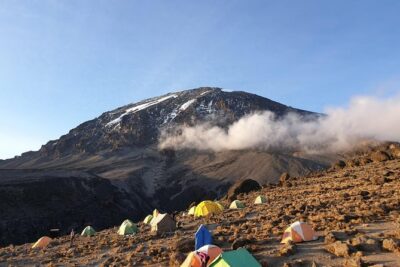
This is where Kilimanjaro begins to feel like a high mountain rather than a forest hike. The trees thin out, the air gets cooler, and the first clear views toward Kibo, the main summit cone, begin to appear.
You follow the Shira Ridge toward the high plateau. The open views are a reward, but the elevation is also your first real test. Walk slowly, drink as directed by your guide, and avoid treating the easier-looking trail as permission to hurry.
The camp setting on the plateau can feel exposed compared with the forest. That is part of the appeal, but weather can shift quickly at altitude. Keep warm layers and rain protection easy to reach rather than buried in your duffel.
Day 3: Shira exploration and Moir Camp
Day 3 is a longer outing across the Shira Plateau. The planned distance is about 8.7 miles, with five to seven hours of walking, and the high point reaches about 13,800 feet.
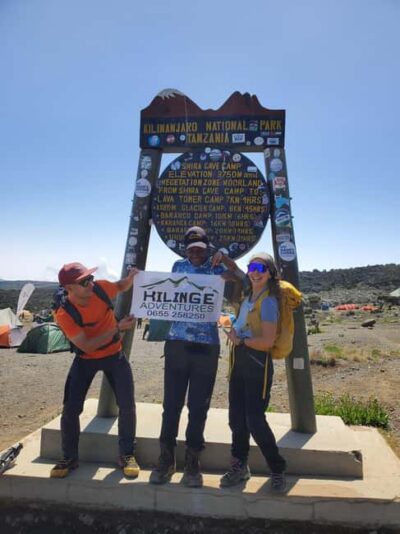
You trek east toward Kibo and may have the option to visit the old collapsed Shira cone. The cone is the remains of one of Kilimanjaro’s three volcanic centers, and it gives the day a sense of place beyond simply gaining height.
The route ends at Moir Camp, set in a large gorge at the end of an old lava flow. This is one of the more unusual camp locations on the trek. It feels remote and stark, with the mountain ahead and little around you besides rock, sky, and high-altitude terrain.
The drawback is that Day 3 is long and takes place at substantial elevation. You may feel fine at the beginning and tired by camp. Keep your pace conservative. This is not a day for proving fitness to the rest of the group.
More treks around the world:
- Mount Etna: Trek to 3000m with cable car and 4×4
★ 4.6 · 3,823 reviews - Bali: Mount Batur Sunrise Trek With Guide and Breakfast
★ 4.8 · 3,461 reviews - From Chania: Full-Day Samaria Gorge Trek Excursion & Guide
★ 4.6 · 3,191 reviews - Mount Etna: Summit Crater Trek with Cable Car
★ 4.8 · 1,875 reviews
Day 4: Lava Tower, Senecio forest, and Barranco Camp
Day 4 is one of the most useful days for acclimatization. The route climbs toward Lava Tower at approximately 15,000 feet, with about 4.3 miles of walking and four to six hours on the trail.
After resting at the tower, you descend through the large Senecio forest and continue toward Barranco Camp, around 13,000 feet. The itinerary describes a waterfall before camp and a setting beneath the Barranco Wall, often with clouds moving through the valley.
This high point followed by a lower camp is exactly the sort of pacing that makes an eight-day climb worthwhile. You get a taste of the altitude you will face later, then sleep at a lower elevation than your highest point of the day.
You should expect this day to feel demanding even though the mileage is modest. The climb toward Lava Tower is slow, and the descent can be hard on tired legs. The reward is a dramatic camp beneath one of Kilimanjaro’s best-known rock walls.
Day 5: Over the Barranco Wall to Karanga
The Barranco Wall is the day’s defining feature. You climb up and over it, then continue through the Karanga Valley on the southern circuit.
The distance is only about 2.2 miles, with four to five hours of walking, and the camp sits at approximately 13,100 feet. Those numbers can look easy on paper. They are not. The terrain and altitude make this a focused mountain day, not a short stroll.
The wall is described as adventurous rather than technical. You will use your hands at points and pay attention to your footing, but this is still part of a non-technical trekking route. A guide’s presence matters here, particularly when the group is moving at different speeds.
I like the way this day breaks up the climb. It gives you a physical feature to concentrate on, then returns you to the broad views of the southern circuit. Karanga Camp also keeps you at a useful altitude before the push toward the summit camps.
Day 6: Kosovo Camp and the final preparation
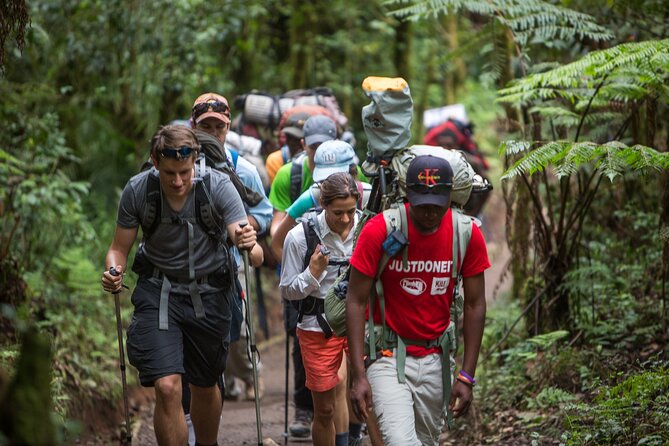
Day 6 takes you slowly to Kosovo Camp at about 16,000 feet. The route covers roughly 2.6 miles and takes five to six hours.
You pass Barafu Camp, where there are strong views toward both Kibo and Mawenzi. Kosovo Camp sits on an exposed ridge, so the plan is to get familiar with the ground before dark. You rest, acclimatize, eat, and prepare for the summit attempt.
This day may feel strangely short in distance but long in effort. At 16,000 feet, every task takes more energy. Keep your evening simple. Organize your summit clothing, headlamp, water, and personal items before trying to rest.
The exposed camp is a practical tradeoff. It puts you in position for the summit, but it can feel more severe than the lower camps. Your guide and crew are especially important here, since good timing, warm food, and clear instructions can make the difference between a calm evening and a frantic one.
Day 7: Stella Point, Uhuru Peak, and the long descent
Summit day begins around midnight. The ascent to Stella Point on the crater rim takes about six to seven hours, followed by roughly one more hour to Uhuru Peak.
You climb through heavy scree between the Rebmann and Ratzel glaciers. This is generally the hardest mental and physical section of the trek. The trail is steep, the air is thin, and progress can feel painfully slow.
Stella Point is a major milestone because you reach the crater rim and see the summit ahead. From there, the route continues to Uhuru Peak at 19,340 feet, the highest point in Africa. The final hour can still be tough, but the goal is visible.
The itinerary lists about 13 miles for the full day, with approximately 5 kilometers of ascent and 12 kilometers of descent. The ascent is scheduled at six to seven hours and the descent at four to six hours, for around 11 hours total. In practical terms, this is a very long day that starts in darkness and ends at Mweka Camp.
After the summit, you descend to Mweka Camp for dinner and celebration. Do not underestimate the downhill portion. Many people focus so hard on reaching the summit that they forget how much work remains after the photographs.
The guide team’s support is central on this day. Guides named on different departures include Goodluck, John, Herment Mosha, Raymond, Amani, Manny, Cinga, Steve, Dastan, Jackson, and others. Your exact team will vary, but the useful thing to look for is a guide who monitors your condition, controls the pace, and keeps the group together rather than pushing blindly toward the top.
Day 8: Mweka Gate and the return to Arusha
The final walk goes from Mweka Camp to Mweka Gate. It covers about 6.4 miles and takes three to four hours, ending around 5,400 feet.
This is a descent through lower terrain, with the mountain experience still fresh. Your legs may be tired, but the air feels easier and the psychological pressure is gone.
At Mweka Gate, the Climb Kili vehicle transfers you back to your Arusha hotel. A shower and a quiet meal will likely feel as important as the summit itself.
The included pickup and return transfer add real value. After eight days on foot, you do not want to negotiate transport while carrying gear and managing tired legs.
What the $2,895 price includes in practical terms
At $2,895 per person, this is not a budget walk. It is also more than a simple park entry and guide fee. The package includes round-trip hotel transfers from Arusha, park admission, camping equipment, meals, and the support of a small-group crew.
The value comes from having the major moving parts arranged in advance. You are not separately organizing camps, food, mountain transport, and permits. That matters on Kilimanjaro, where the logistics are part of the challenge.
The exact value depends on how much you would otherwise spend on a shorter route or a larger group. An eight-day schedule costs more than a rushed climb, but it gives you more time to adjust to altitude. Given that altitude is the main reason people fail to summit, the extra day is a sensible part of the price rather than a luxury add-on.
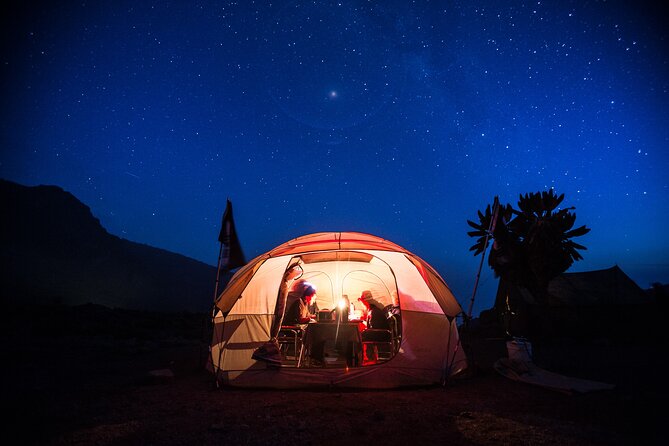
Ask what personal gear you must bring, since the listed inclusions do not specify every item of clothing or equipment. Also confirm the final group composition. The maximum is 15, but some departures have been much smaller, including groups of four or five.
Who should book this Kilimanjaro trek
This trip suits you if you want a structured mountain expedition with a strong support crew and enough time for acclimatization. You do not need advanced technical climbing experience, but you do need strong physical fitness and the ability to walk for many hours over uneven ground.
It is also a good fit for solo people who want to join a group. Several departures have combined solo participants with couples and friends, creating a social setting without requiring you to organize a private party.
You should think twice if you dislike camping, long uphill walks, cold conditions, or early starts. The midnight summit departure is not optional in spirit, since the route is timed for sunrise at Stella Point and the final push to Uhuru Peak.
The small-group promise is useful, but the maximum of 15 is not tiny. If you want the closest possible guide attention, ask whether a smaller departure is available.
Practical details before you commit
Pickup is offered, and the stated meeting time is 8 a.m. Confirmation is provided within 48 hours of booking, subject to availability.
The experience is sold with a mobile ticket, which is convenient for a trip that already involves plenty of physical paperwork and equipment. The cancellation policy allows a full refund if you cancel at least 24 hours before the local start time. Changes or cancellations inside that window are not accepted for a refund.
The experience has a 5 rating based on 186 supplied ratings, with 100 percent recommending it. The strongest praise focuses on guide care, safety, encouragement, food, and the way the crew supports people on summit day. That is exactly where a Kilimanjaro operator earns its fee, so pay attention to those areas when you compare options.
Should you book the 8-day Lemosho trek?
I would choose this trek if your priority is a well-paced route with a strong chance of reaching the summit, rather than the lowest possible price. The Lemosho approach gives you varied scenery, a useful acclimatization schedule, and a memorable progression from forest to glacier country.
Book it if you are ready for a serious physical challenge and value having transport, camps, food, permits, and guides arranged together. Before paying, confirm what personal equipment is excluded and ask how large your particular departure will be.
Skip it if you want a relaxed holiday or dislike sleeping in tents. Kilimanjaro is beautiful, but it demands patience, fitness, and a willingness to keep walking when the air gets thin.
FAQ
How long is the Kilimanjaro trek?
The experience lasts approximately eight days, including the walking day from Mweka Camp to Mweka Gate and the transfer back to your Arusha hotel.
What route does the trek use?
The trek uses the Lemosho route, beginning on the western side of Mount Kilimanjaro and later joining the southern circuit toward the summit.
What is the highest point reached?
The summit is Uhuru Peak at 19,340 feet, or 5,895 meters.
What time does the trek begin?
The stated meeting time is 8 a.m. The summit attempt begins around midnight on Day 7.
How large is the group?
The maximum group size is 15 people. The actual group may be smaller.
Are meals included?
Yes. Meals are included as part of the trek package.
Is camping equipment included?
Yes. Camping equipment is included, and tents are set up at camp for the group.
Is hotel pickup included?
Yes. Round-trip transfers from your Arusha hotel are included.
What fitness level is required?
You should have a strong physical fitness level. The trek includes long uphill sections, high altitude, steep scree, and a summit day lasting about 11 hours.
New treks around the world
- Sapa: 2-Day Local Guided Valley Trek with Night Homestay★ 5.0 · 27 reviews
- SAPA: 1-DAY TREKKING TOUR WITH LOCALS, LUNCH & RICE FIELDS★ 4.7 · 18 reviews
- Sapa: 2-Day Local Guided Valley Trek with Night Homestay★ 4.8 · 5 reviews
- Santa Marta: Trekking in Minca Complete Waterfall Circuit★ 4.4 · 28 reviews
- Santiago: Longueira, Pico de Antónia & Monte Tchota Trek★ 4.8 · 10 reviews
- Santiago: Trek from Serra Malagueta to Rabelados Community★ 5.0 · 16 reviews
- Santiago Island: Serra Malagueta & Tarrafal Beach Trek Tour★ 4.8 · 61 reviews
- Santa Marta: Multi-Day Trek to The Lost City★ 4.8 · 40 reviews
Kilimanjaro Climbs, side by side.
Best Kilimanjaro Adventure 7 days Machame route Trekking
Read our review →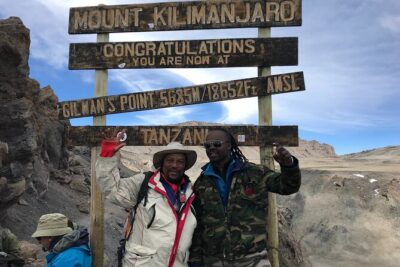
Kilimanjaro 7 Day Private Trekking Experience
Read our review →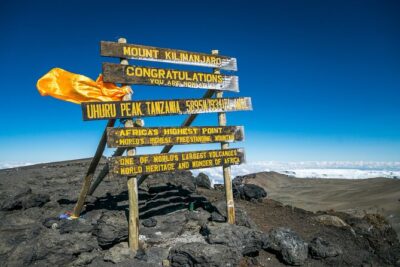
#1. Best 7 days kilimanjaro trek Machame route join group
Read our review →Lists this trek appears in