
Review · AUSTRALIA
Uluru: Guided Trek of Uluru’s Base in a Small Group
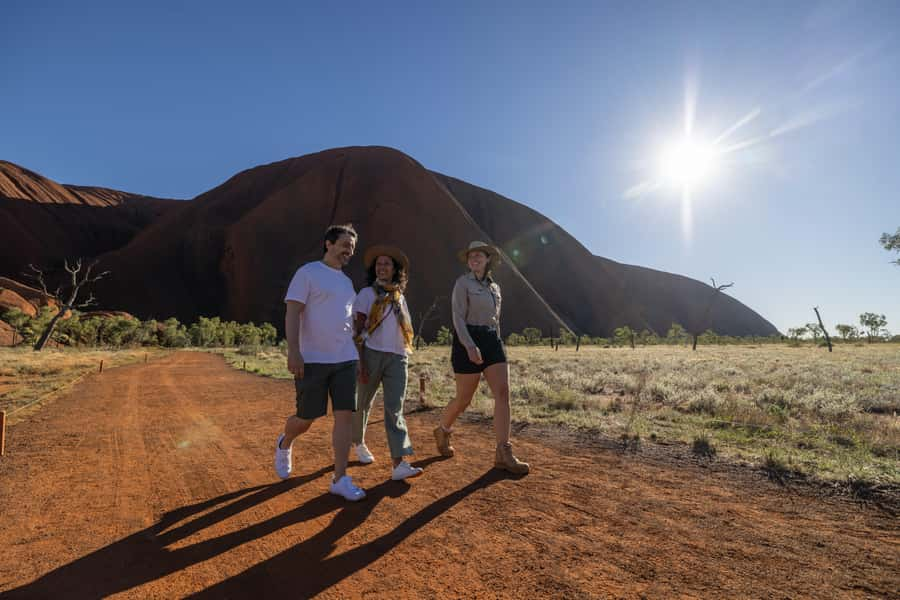
Uluru is most powerful when you stop treating it as a giant photo prop and walk slowly around its base. This six-hour tour gets you onto the full circuit before the heat builds, with sunrise, rock art, waterholes, and Aboriginal stories filling in what your camera cannot show.
I like the small vehicle and group of no more than 11, which makes it easier to hear your guide and ask questions. I also like the way the walk connects places such as Mutitjulu Waterhole and Kantju Gorge to Anangu Tjukurpa, rather than offering only geology and sightseeing. The catch is simple: this is a long walk, usually about 10.5 kilometres, and the early start plus desert heat will test anyone who arrives unprepared.
Key points to know before you book
- Sunrise sets the tone: Start before dawn and watch Uluru change colour as the first light reaches its walls.
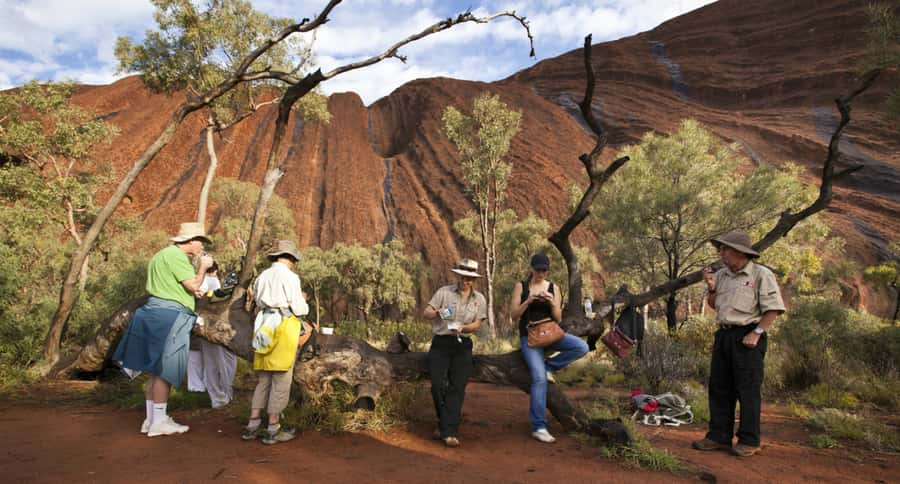
- The full base circuit matters: You see caves, sheer faces, waterholes, rock art, and changing views that are easy to miss from one lookout.
- The guide adds the meaning: Learn about Anangu culture, Tjukurpa stories, survival, plants, animals, geology, and sacred places.
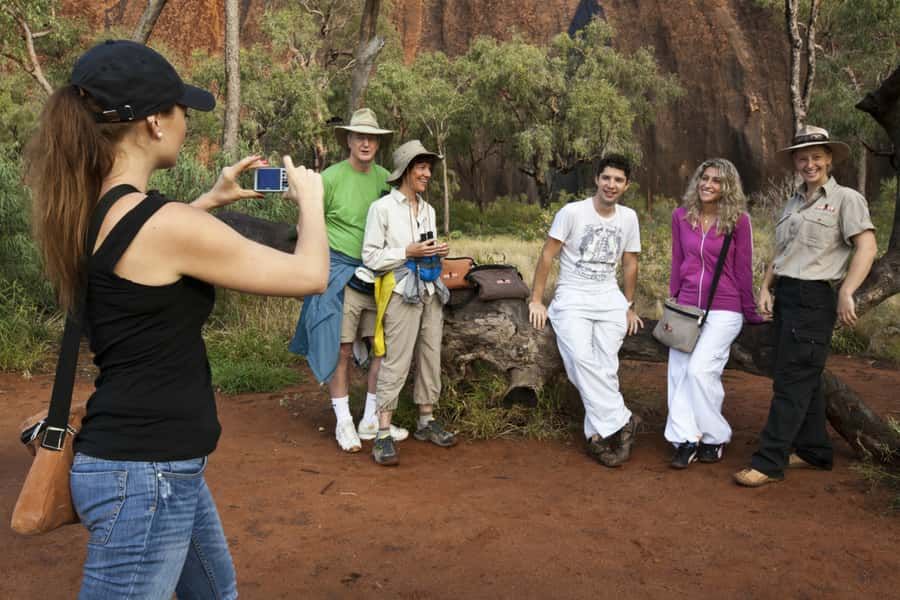
- Small really helps: Transport holds a maximum of 11 participants, giving the walk a more personal feel.
- Pack for distance and weather: Bring water, sturdy shoes, a hat, sunscreen, and a warm layer for the cool morning.
- Budget for the park pass: The $169 tour price does not include entry to Uluru-Kata Tjuta National Park.
Why walking the full base changes your view of Uluru
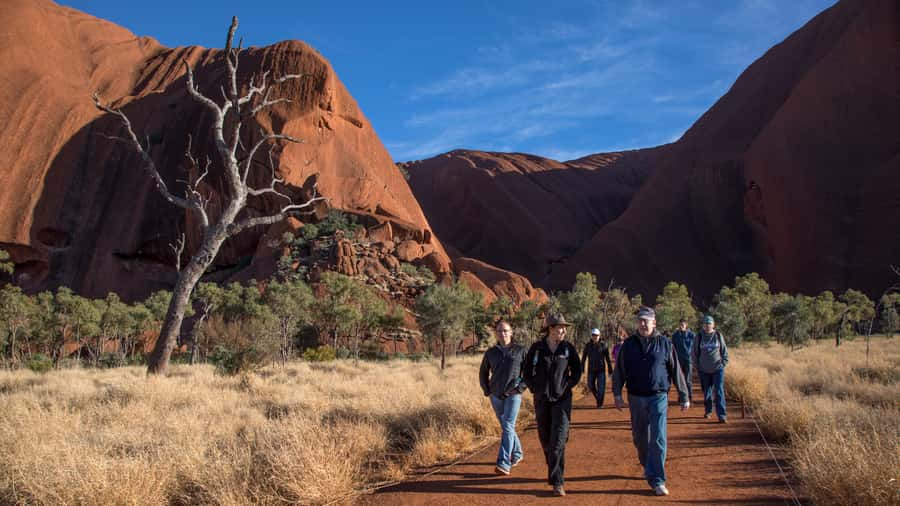
From a distance, Uluru can look like one enormous slab of red rock. The base walk corrects that first impression. As you circle it, the rock keeps changing: smooth walls give way to deep folds, caves, overhangs, water channels, and shaded recesses.
The route also helps you understand why the Anangu people ask visitors to treat Uluru as a sacred place. The important sites are not just scenic stops. They connect to Tjukurpa, the creation stories and law that guide Anangu life, culture, and care for Country.
Your guide explains these connections as you walk. Guides such as Lucia, Michael, Lily, Rachel, Max, and Dimitri have been praised for making the stories clear, friendly, and easy to follow. The quality of a tour like this depends heavily on the person leading it, but the repeated strength here is the human side of the experience: guides watch the group, set a sensible pace, stop for questions, and explain why a particular mark, cave, or waterhole matters.
You can walk the base independently, but doing so may leave you with a series of impressive views and little context. With a guide, the rock becomes a place with people, memory, law, and stories attached to it.
More guided trips around the world
- Bali: Mount Batur Sunrise Trek With Guide and Breakfast
★ 4.8 · 3,461 reviews - From Chania: Full-Day Samaria Gorge Trek Excursion & Guide
★ 4.6 · 3,191 reviews - La Palma: Tajogaite Volcano Guided Trek
★ 4.8 · 1,810 reviews
Before dawn, from Ayers Rock Resort to the park
Pickup is from outside your hotel reception at Ayers Rock Resort, about an hour before sunrise. If you are staying at Emu Walk Apartments, you meet the vehicle at Desert Gardens Hotel. Guests at The Lost Camel use Sails in the Desert as their pickup point.
The transport is a comfortable vehicle for a maximum of 11 people. That is a useful middle ground. You avoid the impersonal feel of a large coach, but you also do not have to arrange your own early-morning drive into the park.
The timing is part of the appeal and part of the price. You lose a night of sleep, but you gain the coolest section of the day and a chance to see Uluru before the sun is high. In warmer months, an early start is not just pleasant. It is sensible.
Bring a warmer layer in the cooler months. September visitors have found the morning surprisingly cold, even though the day later becomes warm. A pullover takes little room and can make the first hour much more comfortable.
You need a separate Uluru-Kata Tjuta National Park entry ticket. It can be bought at the entry station and is valid for three consecutive days from the date of issue. If you are spending several days in the Red Centre, that pass can cover other park visits as well.
Sunrise at Uluru, the best first stop
You begin walking before sunrise and stop at a suitable point to watch the light arrive. This is not a quick photo pause. The point is to see the rock and the surrounding scenery change slowly.
At first, Uluru may appear dark and muted. As the sun rises, its walls take on warmer reds and oranges, while grooves and ridges become easier to read. The effect is especially strong because you are close to the base, not looking at the rock from a distant viewing platform.
I would keep your camera ready, but do not spend the whole time looking through it. Sunrise is one of the few parts of the outing that does not require explanation. The quiet, changing light does much of the work.
The sunrise timing also sets up the rest of the walk well. You are out early, and the route begins before the harshest heat. Still, the walk continues for hours, so do not mistake a cool start for a cool day.
Kuniya Walk and Mutitjulu Waterhole
One of the most meaningful sections follows the Kuniya Walk toward Mutitjulu Waterhole. Here, the guide shares the Tjukurpa story of Kuniya and Liru, linking the visible features of Uluru to Anangu cultural knowledge.
Mutitjulu Waterhole is a welcome change from the open track. Water has enormous importance in Central Australia, and a waterhole at the foot of Uluru helps explain why this place has long mattered to people living in an arid region.
Your guide also talks about survival, native plants, animals, and the way people read and use the environment. This is where the tour moves beyond a rock formation and becomes a lesson in living well in a demanding place.
The waterhole is one of the spots where you should slow down. Let the guide finish the story, look closely at the rock surfaces, and notice how much cooler and more sheltered the area feels. You may also find that the route becomes more crowded at popular points, so the small group is useful when your guide gathers everyone together.
More treks around the world:
- Mount Etna: Trek to 3000m with cable car and 4×4
★ 4.6 · 3,823 reviews - Mount Etna: Summit Crater Trek with Cable Car
★ 4.8 · 1,875 reviews - Etna: summit craters trekking with volcano guide 3350mt
★ 4.7 · 1,712 reviews - From Rethymno: Samaria Gorge Full-Day Trek, Pickup & Guide
★ 4.5 · 1,610 reviews
Rock art, caves, and the stories on the walls
Along the base you visit rock art sites and see markings, caves, and overhangs. Some of the marks may look simple at first. Their importance comes from the cultural setting and the explanation that accompanies them.
Your guide covers how the sites relate to Anangu life and Tjukurpa. The emphasis is not simply on how old the markings might be. It is on the knowledge carried through stories, place, and custom.
This is also a good reason not to rush the circuit. A self-guided walk can make it tempting to move from one viewpoint to the next. A guided walk gives you time to stop at less obvious features and understand what you are seeing.
Please follow your guide’s directions around culturally sensitive places. Uluru is not an empty public sculpture. Some areas have rules about photography, access, or respectful behavior. The guide helps you see more while keeping the visit appropriate.
Mala Walk and Kantju Gorge
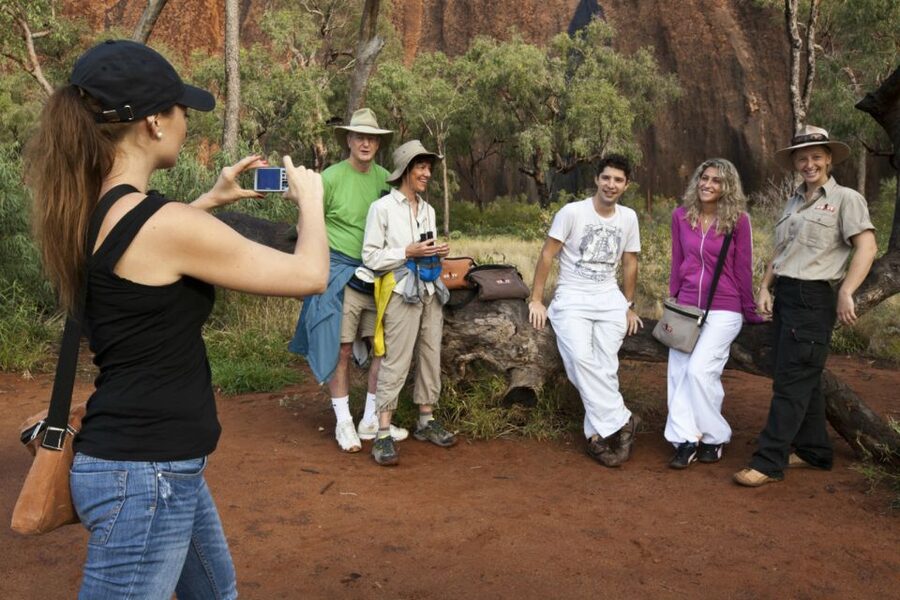
Later, the route includes the Mala Walk and Kantju Gorge. Here, you hear the story of the Mala people and see another side of Uluru’s physical character.
Kantju Gorge is known for its tall rock walls and enclosed feel. It shows how different the base can look from one section to the next. One minute you are walking beside open red rock, and the next you are looking into a narrow, shaded space shaped by water and weather.
This stop rewards patience. The gorge is not important only because it photographs well. It gives you a better sense of the forces that shaped Uluru and the places where water can collect after rain.
Your guide may explain the geology alongside the cultural story. That combination is valuable. You learn how the rock formed, but also why this particular place carries meaning for the Anangu.
The route is generally flat and made up of gravel tracks, so the walking is not technical. The challenge is distance. You may walk for roughly five hours with stops, and some people record a longer distance than the advertised 10.5 kilometres. One independent GPS reading came out at just over 14 kilometres, so I would prepare for a substantial day on your feet.
Breakfast on the track
An outback picnic breakfast comes in a carry pack, with tea and coffee supplied. You carry the food yourself, so it is designed to be practical rather than elaborate.
For many people, the breakfast is enough to keep them going. If you have a large appetite, you may find it light, a point worth noting because the walk is long. Eat something before pickup if you know you need a substantial breakfast, but avoid carrying extra weight unless necessary.
There are rest stops along the route, and past participants have noted toilets and water refill points. The provided information recommends bringing a water bottle, and you should take that seriously. You are walking in a dry environment for several hours.
A useful approach is to start with enough water for the early section and use refill points as needed, but do not assume the water will be cold. One detailed account describes the refill water as filtered rainwater with an earthy or metallic taste. An insulated bottle can make the day more pleasant.
Some guides have added thoughtful touches, such as chilled lemongrass towels in hot weather. Treat that as a possible bonus, not a guaranteed inclusion. The dependable provisions are the picnic breakfast, tea, coffee, transport, and guide.
What the $169 price buys you
At $169 per person, this is not the cheapest way to see Uluru. The comparison is not just with a free self-guided walk, though. You are paying for early hotel pickup, transport into the park, a professional guide, a full base circuit, breakfast, and six hours of structured time.
I think the price makes the most sense if this is your main Uluru experience and you want cultural context. You cover a great deal of ground, and the guide helps you use that time well. You also avoid the stress of arranging a pre-dawn arrival and navigating the route alone.
The value is weaker if you only want sunrise photos or if you dislike long walks. In that case, a shorter viewing experience may suit you better, though it will not offer the same close look at waterholes, rock art, gorges, and changing base scenery.
Remember to add the national park ticket to your budget. Since that ticket lasts three consecutive days, it may provide good value if you also visit Kata Tjuta during your stay.
The tour has a 4.8 rating from 182 reviews, and the strongest praise centers on the guides, personal group size, steady pace, and cultural explanations. A small number of practical criticisms are useful too: one person wanted a more filling breakfast, and walking distances can exceed the stated figure. Those are not reasons to avoid the tour, but they are reasons to pack intelligently.
Heat, footwear, and the real fitness requirement
You do not need to climb, scramble, or tackle steep mountain trails. The route is mostly flat and easy underfoot. That does not make it effortless.
The main test is walking for hours in a remote, exposed setting. A previously fit person may find the pace comfortable, especially with regular stops. Someone unused to long walks may find the final section tiring, particularly as the temperature rises.
Wear sensible walking shoes with good support. Bring a hat, sunscreen, sunglasses, and clothing that covers your shoulders. In cooler months, add a warm layer for the start. In hot months, protect yourself from the sun even if the morning begins pleasantly.
Fly protection may also help. One person specifically recommended a face fly net, which sounds fussy until you are dealing with persistent flies in the open desert. It is not listed as supplied, so bring one if you are bothered by insects.
Guides generally set a measured pace and allow rest stops. They also manage the route direction to limit later sun exposure when possible. Still, you should not count on the guide to solve poor preparation. Carry water, eat enough, and speak up if you need a break.
Audio guides and language options
The live guide speaks English. Optional audio guides are available in Spanish, Chinese, French, German, Italian, and Russian.
This is useful if you understand English but would rather hear cultural and historical details in another language. It can also help members of a mixed-language group follow the content more comfortably.
The live guide remains central to the experience. The audio option does not change the small-group transport or the need to keep up with the walking schedule. Check language availability when booking if this feature is important to you.
Who will enjoy this Uluru walk most
I would choose this tour if you want to understand Uluru as a cultural place, not just photograph it. It suits people who like walking, asking questions, and giving a full morning to one major sight.
It is also a strong choice for first-time visitors who want an organized introduction. The guide covers geology, plants, animals, Aboriginal culture, survival, and history in one outing, while the route provides plenty of visual variety.
Families with older children may enjoy it if everyone can manage the distance. An infant price includes touring and a child seat, but the adult walking requirement still matters. The tour is not a short outing designed around quick stops.
I would think twice if you have limited mobility, dislike early mornings, or know that 10.5 kilometres in desert conditions is beyond your comfort level. The track is flat, but the duration and heat remain real factors.
Should you book the Uluru base walk?
Book it if you want the fullest guided introduction to Uluru in one morning. The combination of sunrise, a full base circuit, Mutitjulu Waterhole, Kantju Gorge, rock art, breakfast, and Anangu stories gives you far more than a quick lookout visit.
The best reason to book is the guide. People such as Michael, Lily, Lucia, Rachel, Max, and Dimitri have brought warmth and care to the walk, and that personal connection is what turns scenery into understanding.
Skip it if you want a relaxed short stop, a late start, or a large breakfast. For everyone else, pack sturdy shoes, water, a hat, and a warm layer. Accept the early alarm and the long distance, and the $169 price becomes a fair charge for a full, thoughtful day around one of Australia’s most important places.
FAQ
How long is the Uluru base walk?
The tour lasts six hours, including transport, stops, breakfast, and guiding. The walking distance is approximately 10.5 kilometres, although some people record more than that on their GPS devices.
What time does the tour start?
Pickup is approximately one hour before sunrise. Starting times change by date, so check availability for the exact time of your visit.
Is hotel pickup included?
Yes. Pickup is included from hotels within Ayers Rock Resort. Emu Walk Apartments guests meet at Desert Gardens Hotel, while guests at The Lost Camel meet at Sails in the Desert.
Is the national park entry fee included?
No. Uluru-Kata Tjuta National Park entry is separate. You can buy a ticket at the entry station, and it is valid for three consecutive days from the date of issue.
What food and drinks are provided?
You receive an outback picnic breakfast in a carry pack, along with tea and coffee. You should still bring a water bottle for the walk.
What languages are available?
The live guide speaks English. Optional audio guides are available in Spanish, Chinese, French, German, Italian, and Russian.
How many people are in the group?
Transport and the tour group are limited to 11 participants. This keeps the outing smaller than a standard coach tour and makes it easier to hear and speak with the guide.
New treks around the world
- Sapa: 2-Day Local Guided Valley Trek with Night Homestay★ 5.0 · 27 reviews
- SAPA: 1-DAY TREKKING TOUR WITH LOCALS, LUNCH & RICE FIELDS★ 4.7 · 18 reviews
- Sapa: 2-Day Local Guided Valley Trek with Night Homestay★ 4.8 · 5 reviews
- Santa Marta: Trekking in Minca Complete Waterfall Circuit★ 4.4 · 28 reviews
- Santiago: Longueira, Pico de Antónia & Monte Tchota Trek★ 4.8 · 10 reviews
- Santiago: Trek from Serra Malagueta to Rabelados Community★ 5.0 · 16 reviews
- Santiago Island: Serra Malagueta & Tarrafal Beach Trek Tour★ 4.8 · 61 reviews
- Santa Marta: Multi-Day Trek to The Lost City★ 4.8 · 40 reviews