
Review · CATANIA
Mount Etna: Guided Trek 3,000 Meters to the Summit
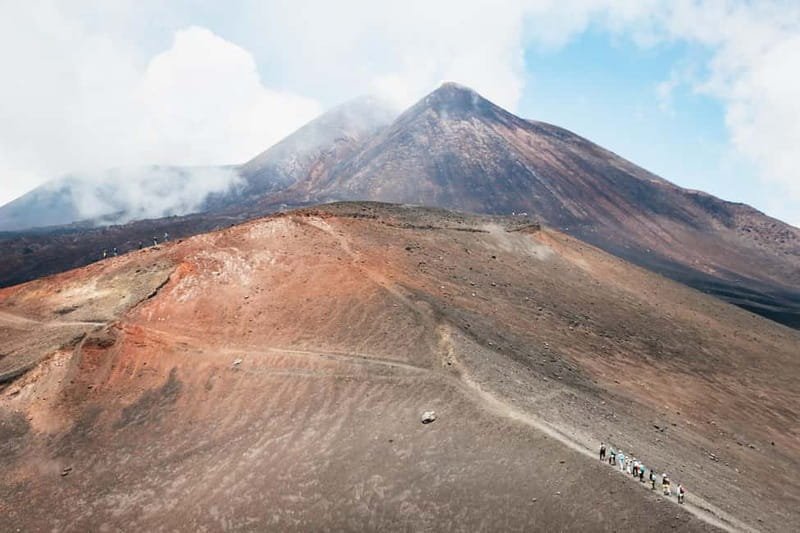
Mount Etna gives you a rare chance to walk high on an active volcano without committing to a technical climb. This six-hour outing takes you by cable car to about 2,500 meters, then on foot toward the summit craters at roughly 3,000 meters, across black ash, old lava, and fresh volcanic ground.
I like the volcanologist guides, who turn a tough walk into a lesson about Etna’s eruptions and geology. I also like the careful pacing. Luca, Marco, and Manuel are praised for keeping mixed-ability groups together. The main drawback is cost: the advertised price is $113.29, but a cable car charge of €50 is also listed as payable on site, so confirm the final total before booking.
Key points to know
- Reach about 3,000 meters: This is a high-altitude trek over loose ash and volcanic rock, not a simple sightseeing walk.
- Ride before you hike: The cable car saves the long lower climb and leaves you with the most dramatic upper section.
- Look for the 2001 Crater: At about 2,700 meters, it still fumes and gives you a close look at Etna’s recent activity.
- Expect changing conditions: Wind, ash, rain, snow, and volcanic risk can alter or stop the route.
- Bring serious weather protection: High hiking boots, warm layers, gloves, a hat, sunglasses, and a face covering are all useful.
- Best for moderately fit adults: You need to walk on loose sand and rock, with some exposed sections and no regular trail.
Walking into Etna’s upper volcanic world
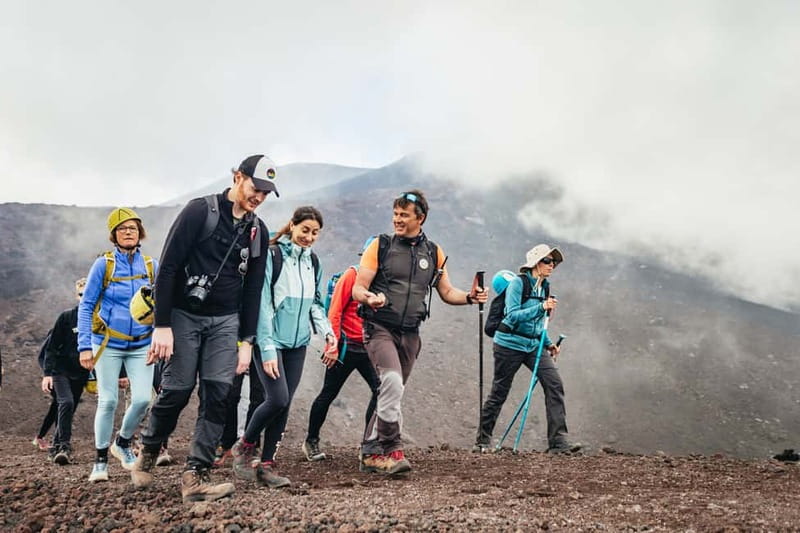
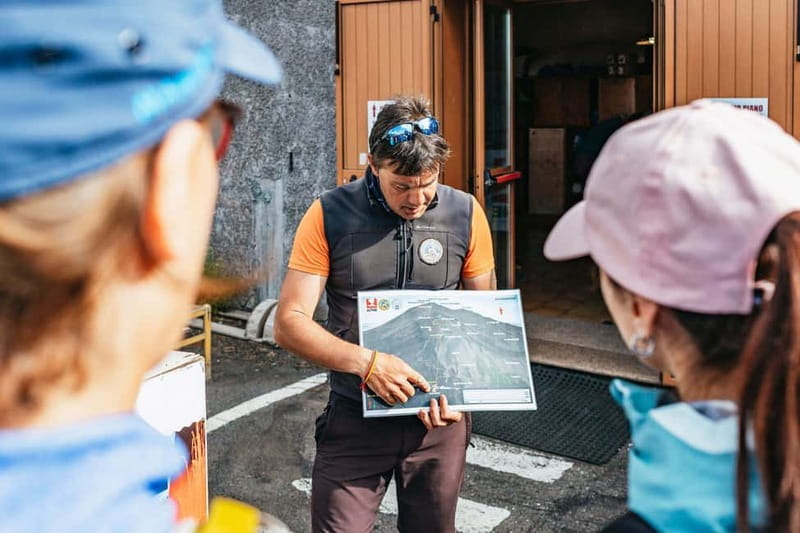
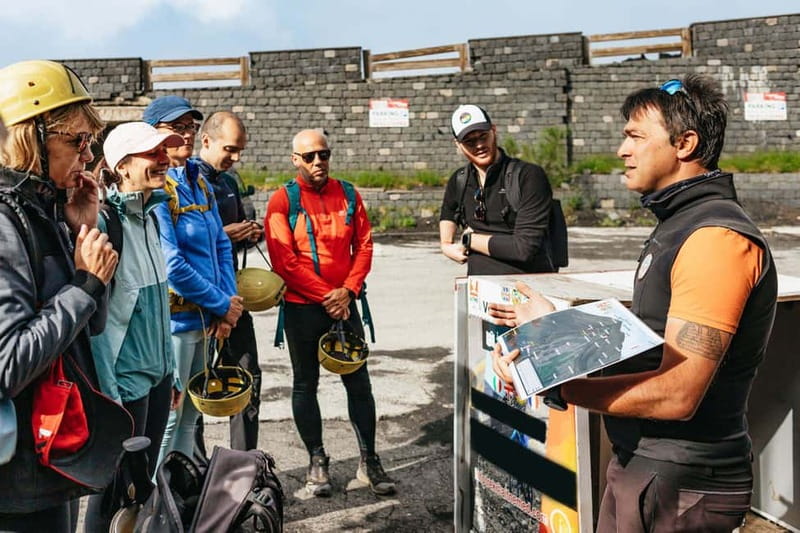
The meeting point is La Terrazza Dell’Etna. From there, you receive a briefing, meet the guide, and prepare for the ascent. The group then heads to the cable car for the ride upward.
That opening ride matters. Mount Etna is enormous, and walking from the lower slopes to the upper zone would turn this into a much longer and harder outing. The cable car places you near the high volcanic terrain, where the ground becomes darker, rougher, and more severe.
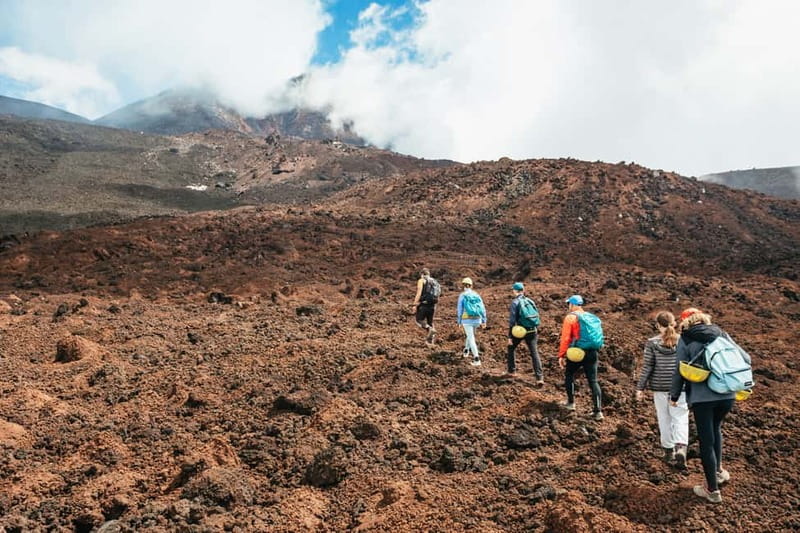
From the upper station, you hike toward the summit craters. The route crosses old lava flows and newer volcanic deposits, with the guide explaining how each surface formed. You are not simply walking to a viewpoint. You are reading Etna under your feet.
The advertised high point is about 3,000 meters. The exact route and altitude can change with volcanic conditions, weather, and safety decisions. Some descriptions of the outing refer to slightly different upper points, so treat the stated altitude as a target rather than a promise of a fixed summit landing.
More volcano treks around Catania:
- Etna Sunset Tour: Volcano trek, Cave & tasting from Catania
★ 4.8 · 1,290 reviews - From Catania: trek on Mount Etna, Lava Cave & tasting Tour
★ 4.8 · 563 reviews - Mount Etna: North Upper Craters Guided Tour by 4×4 with Trek
★ 4.6 · 243 reviews
The cable car saves your legs for the best part
The cable car ride takes about 20 minutes each way. It offers a quick change from the lower mountain to Etna’s high slopes, and you begin to see why this volcano is such a powerful part of Sicily’s identity.
The cable car is also one of the practical reasons this trip can fit into six hours. You spend your energy on the upper section, where the volcanic ground and views are the main attraction, instead of using it all on the approach.
There is an important money detail here. The activity information includes the cable car among the features, but it also says the cable car ticket costs €50 and is paid on site. That is a clear inconsistency. I would contact the provider before departure and ask if the €50 is already included in your booking or must be added. One price note in the supplied information also mentions paying for a cable car or bus transfer, with different amounts reported, so a written confirmation is wise.
The cable car ride itself is not the difficult part. The walk begins after you get off.
A two-hour climb across ash, lava, and loose rock
The first major hiking section lasts about two hours. You move through a stark volcanic zone with old and recent lava flows, ash, and rock rather than a normal mountain path.
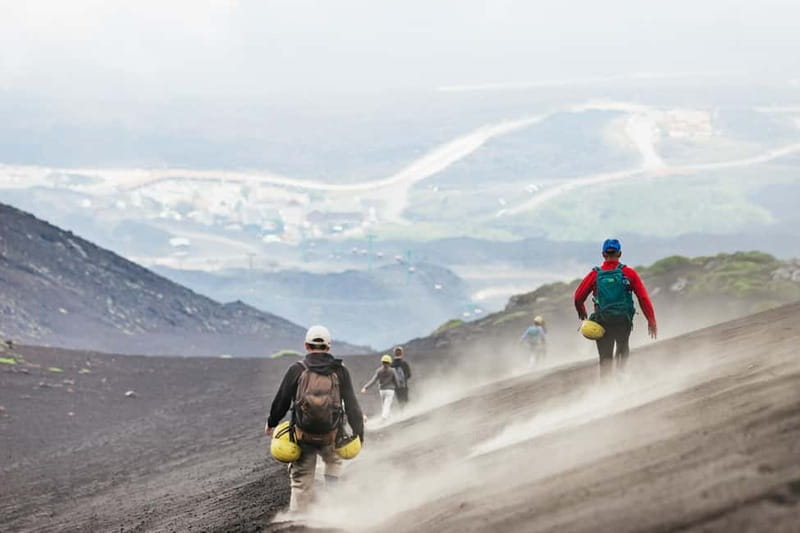
That surface changes the feel of the hike. Loose volcanic pebbles can slip beneath your boots, and ash may blow into your face. High boots with good ankle coverage are a smart choice because small stones can work their way inside. Long trousers also help keep grit out.
The walk is described as suitable for people with medium physical training. That is a fair warning. You do not need special climbing skills, but you should be comfortable walking uphill over sand and rock when there is no clear trail. Some sections may be exposed, and the descent can be harder than the climb because loose material moves underfoot.
I would not judge this outing by distance alone. Altitude, wind, uneven footing, and the thin feel of the air can make a moderate route feel demanding. Tell your guide about any health concerns before setting off, and do not treat the group pace as a challenge to beat.
Guides such as Luca are praised for setting a steady rhythm and waiting for the group to stay together. That is especially helpful if your party includes people with different fitness levels. The walk is more enjoyable when you can stop to listen instead of rushing to keep up.
The summit craters reward the effort
At the upper point, you reach the base of Etna’s summit craters. This is the main prize of the outing: high volcanic ground, broad views, and the feeling of being close to a living geological system.
The views depend heavily on the weather. On a clear day, you can look across Etna’s dark upper slopes and far beyond. In cloud or heavy wind, the experience becomes more about the crater edges, ash, and volcanic textures directly around you. Both can be memorable, but they are very different days.
The guide adds real value here. A volcanologist can explain the difference between old lava and newer deposits, point out the effects of eruptions, and give meaning to the craters instead of leaving you with a dramatic but vague photo stop.
The route may circle crater edges or visit several craters when conditions allow. One outing included a route around five craters, while another group dealt with very strong winds and limited visibility. That contrast shows why the guide’s judgment matters more than a fixed sightseeing script.
Do not expect a guaranteed view of the actual summit or a single perfect crater rim. Etna is active, weather changes quickly, and access can be restricted for safety. The point is to experience the upper volcano responsibly, not to force a particular photograph.
More guided trips around Catania
- Piano Provenzana: Guided Mt. Etna Snowshoeing Trek
★ 5.0 · 3 reviews - Bali: Mount Batur Sunrise Trek With Guide and Breakfast
★ 4.8 · 3,461 reviews - From Chania: Full-Day Samaria Gorge Trek Excursion & Guide
★ 4.6 · 3,191 reviews - La Palma: Tajogaite Volcano Guided Trek
★ 4.8 · 1,810 reviews
The 2001 Crater shows Etna’s recent side
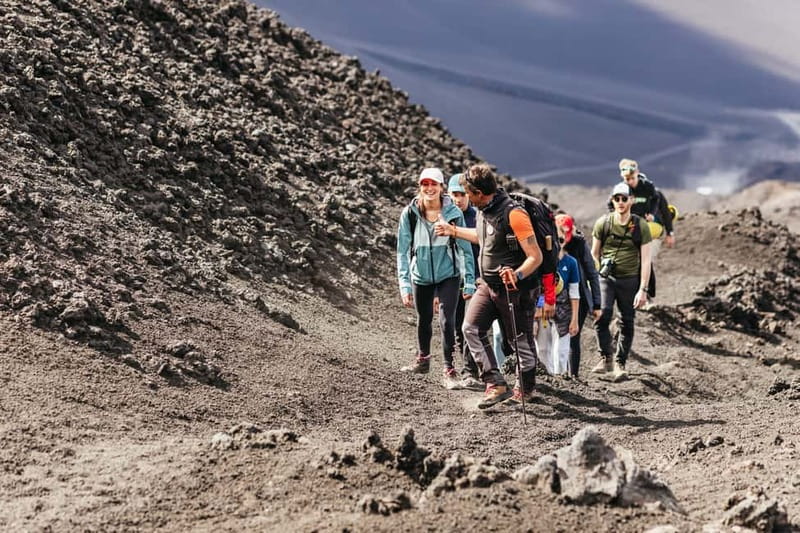
During the descent, the group stops at the 2001 Crater at around 2,700 meters. It still fumes, making it one of the most interesting stops on the route.
This crater gives you a useful sense of Etna’s timeline. You are not looking at a formation from some distant geological age. You are seeing the result of a relatively recent eruption, with heat and gases still part of the scene.
Wind direction matters here. Volcanic gases and ash can blow toward the path, so bring a scarf, buff, or other face covering. Sunglasses protect your eyes from sun and drifting grit, while contact lenses are forbidden because of the volcanic ash carried by the wind.
The stop is not just a photo opportunity. It helps connect the guide’s explanations to something you can see and feel. Etna’s eruptions are not an abstract subject when a crater is still giving off fumes beside you.
The descent is shorter but not necessarily easier
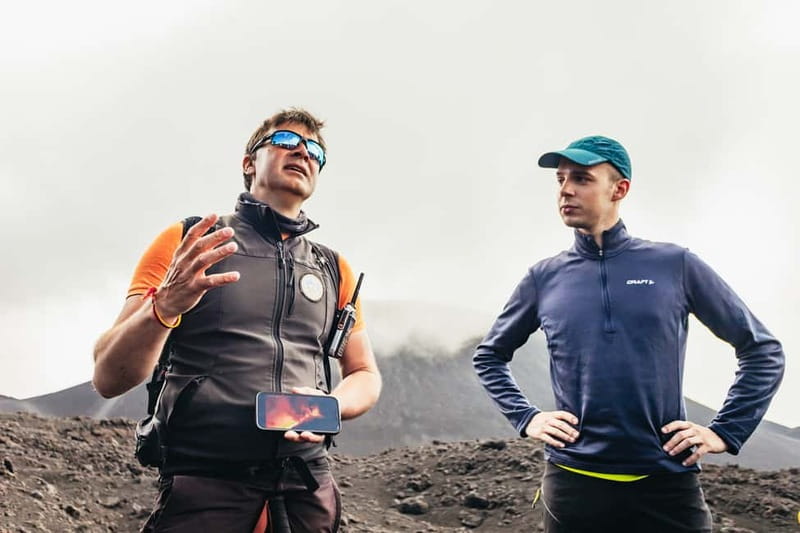
After the summit section, you descend toward 2,500 meters. The itinerary gives about an hour and a half for this second hiking section, followed by the cable car ride down.
Loose ash and small stones can make downhill walking awkward. Use trekking poles if you have them, and take controlled steps rather than sliding quickly. Poles and helmets are supplied, though bringing or using an additional trekking pole is recommended in the practical advice.
The descent is also when tiredness catches up. A route that felt manageable in the morning can feel less secure after several hours in wind and sun. Good footwear, long socks, and a sensible pace make a noticeable difference.
Lunch is not included. Bring at least 1.5 liters of water, a snack, and a packed lunch in a 10 to 20-liter backpack. There is a planned break on the way down, so you should not rely on finding food at the high point.
Once you return to the cable car, the ride back takes about 20 minutes. The activity finishes where it began at La Terrazza Dell’Etna. Hotel pickup and drop-off are not included, so you need to arrange your own transport to the meeting point.
Guides are the strongest part of the experience
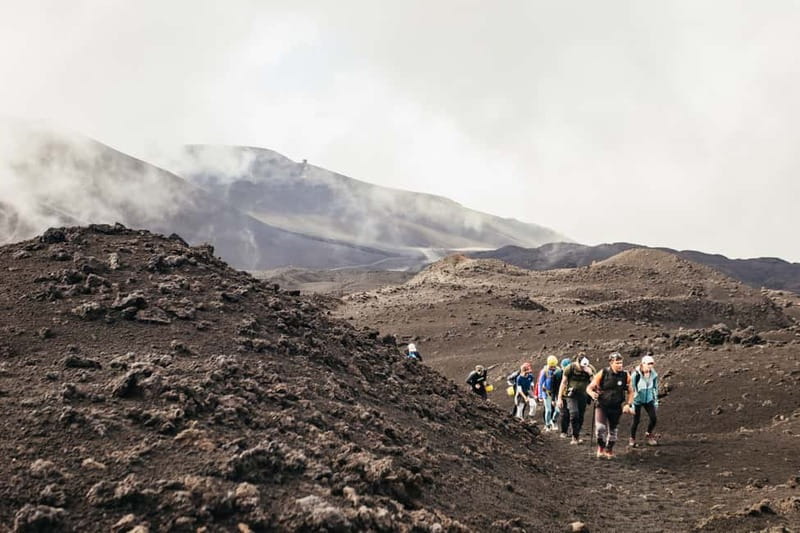
The guide can make or break a mountain outing, and this is where the experience earns much of its value. Luca is repeatedly singled out for his humor, patience, geology explanations, and ability to remember people’s names. Marco is also praised for making the walk interesting and manageable, while Manuel is noted for adapting the route during difficult weather.
Those details matter because a high-altitude volcano requires judgment. The guide decides when weather, environmental conditions, or volcanic risk make a route unsafe. The schedule can be changed or interrupted without warning, and that is a strength rather than a failure when dealing with an active volcano.
English and Italian tours are available. The guide provides helmets, trekking poles, and insurance. Some participants were also lent hiking shoes and windproof jackets, but I would not assume that equipment is always available. Ask the provider ahead of time if you need loan gear.
The best guides also keep the scientific side understandable. You can expect explanations about Etna’s geology, lava surfaces, eruption history, and the region around the volcano. This makes the experience more than a strenuous walk with a view.
What to wear for a mountain that can change its mind
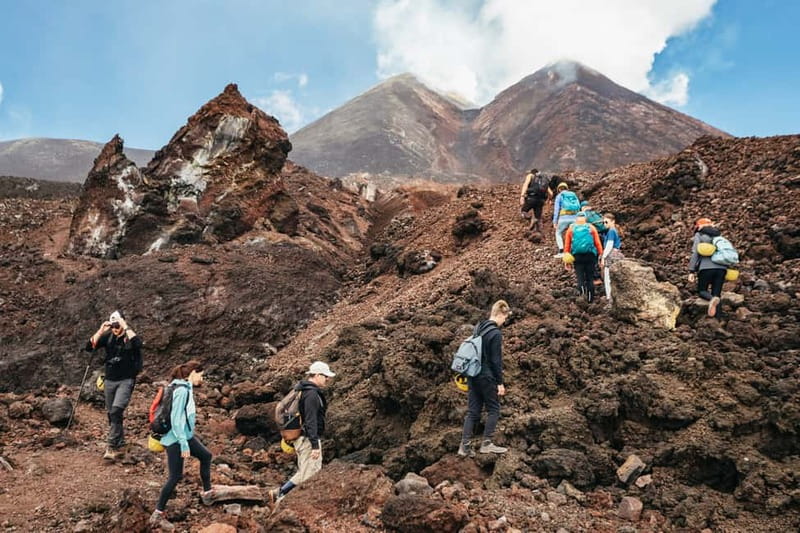
At 3,000 meters, Sicilian sunshine does not guarantee warmth. Bring warm clothing, a windproof jacket or anorak, gloves, and a hat. An extra T-shirt is useful after several hours of walking.
Your footwear matters more than your clothes. Wear proper hiking shoes or trekking boots with high socks, preferably with coverage above the ankle. Avoid smooth-soled trainers. Ash and pebbles can make footing uncertain, especially on the way down.
Pack:
- Sunglasses
- Sunscreen
- At least 1.5 liters of water
- A snack and packed lunch
- Warm layers and rain protection
- A face covering for ash and fumes
- A 10 to 20-liter backpack
Contact lenses are not allowed because wind can spread volcanic ash. If you use them, bring suitable glasses instead.
The outing is not suitable for children under 10, pregnant women, people with mobility impairments, heart problems, vertigo, or respiratory issues. Those limits are sensible. There are no regular trails in some parts, some ground is exposed, and the combination of height, ash, and fumes is not forgiving.
Is $113.29 a fair price?
At $113.29 per person, the tour can be good value if the price really includes the guide, equipment, insurance, and cable car. A specialist guide is particularly useful here because access, weather, and volcanic hazards are not simple matters.
The extra €50 cable car charge is the key concern. Since the supplied details conflict, your real cost could be higher than the headline price. Ask for the full amount before booking, including any cable car, bus, or equipment fees.
You are paying for more than transport to a mountain. The price covers a guide who manages the route, explains the volcano, and helps the group respond to changing conditions. It also saves you from organizing the upper mountain logistics yourself.
The value is strongest if you want a proper volcanic hike rather than a quick cable car viewpoint. If you only want photographs and a short walk, this six-hour trip may be more effort than you need.
Free cancellation is available up to 24 hours before the activity, and you can reserve now and pay later. Those terms help if your Sicilian plans depend on weather, but they do not guarantee that the route will operate as advertised on a given day.
Who should book this Etna trek?
I would choose this tour if you want to understand Etna while walking through its upper volcanic zone. It suits adults with moderate fitness who are comfortable on uneven ground and willing to pack for cold, wet, windy, and dusty conditions.
It is a strong choice for anyone who values a guide’s explanations. Luca, Marco, and Manuel are all associated with the qualities you want here: patience, humor, route awareness, and clear information about the volcano.
I would think twice if you dislike loose rock, exposed sections, high altitude, or uncertain weather. This is not a gentle nature walk. You may face strong wind, rain, frost, snow, ash, or a shortened route, even in a season that seems warm at sea level.
Should you book it?
Yes, if you want the most active version of a Mount Etna visit that fits into half a day. The summit craters, the still-fuming 2001 Crater, the cable car, and the guide’s volcanic expertise create a much fuller experience than a simple viewpoint stop.
Before paying, confirm the cable car cost, meeting details, language, and equipment availability. Then pack warm layers, sturdy boots, food, water, and something to cover your face.
Book this for the chance to walk on Etna, not for a guaranteed summit photograph. If the weather cooperates, you get an extraordinary high-altitude route. If it does not, the guide’s safety decisions are part of the deal.
FAQ
How long does the Mount Etna trek last?
The activity lasts about six hours, including the cable car rides, the guided hike, stops, and the return to La Terrazza Dell’Etna.
Where does the activity start and finish?
You meet at La Terrazza Dell’Etna. The activity ends back at the same meeting point.
Is the cable car ticket included?
The details are inconsistent. The activity information lists the cable car ticket as included, but it also says that a €50 cable car ticket must be paid on site. Confirm the final price with the provider before booking.
What languages are available?
The tour is offered with a live guide in English or Italian.
What should I bring?
Bring sunglasses, sunscreen, hiking shoes or trekking boots, warm clothing, gloves, a hat, a windproof jacket, at least 1.5 liters of water, a snack, packed lunch, and a 10 to 20-liter backpack. A face covering is also useful around ash and volcanic fumes.
Who should not take this activity?
It is not suitable for children under 10, pregnant women, people with mobility impairments, heart problems, vertigo, or respiratory issues. You should also tell the guide about any health conditions or concerns before the trek.
New treks around Catania
- Piano Provenzana: Guided Mt. Etna Snowshoeing Trek★ 5.0 · 3 reviews
- Mount Etna: trek with vintage car, tasting sicilian produtcs★ 5.0 · 5 reviews
- Mount Etna: Day trip to the high altitude craters at 3000 meters trekking★ 5.0 · 2 reviews
- From Syracuse: Mount Etna Volcano Morning Trekking Tour★ 5.0 · 3 reviews
- From Catania: Mount Etna Trekking Private Experience★ 4.6 · 11 reviews
- Etna: Trekking to the summit craters at 3340 meters★ 4.0 · 10 reviews
- Catania: Etna Sunset Trekking with Hotel Pickup★ 5.0 · 2 reviews
- Catania: Etna Morning or Sunset Trek with Lava Tunnel & Gear★ 5.0 · 27 reviews
Volcano Treks, side by side.
Mount Etna: Trek to 3000m with cable car and 4×4
Read our review →
Mount Etna: Summit Crater Trek with Cable Car
Read our review →
Etna: summit craters trekking with volcano guide 3350mt
Read our review →
Catania: Mount Etna Trekking Tour Beyond the Tourist Trails
Read our review →
Etna Sunset Tour: Volcano trek, Cave & tasting from Catania
Read our review →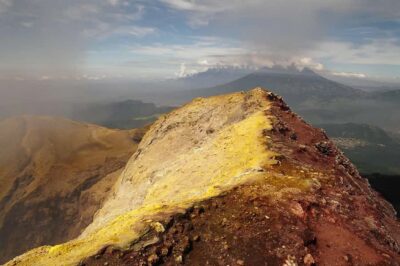
From Catania: trek on Mount Etna, Lava Cave & tasting Tour
Read our review →Lists this trek appears in